Residential classifications
Class 1Class 2Class 3Class 4
Class 1
(1) A Class 1 building is a dwelling.
(2) Class 1 includes the following sub-classifications:
(a) Class 1a is one or more buildings, which together form a single dwelling including the following:
(i) A detached house.
(ii) One of a group of two or more attached dwellings, each being a building, separated by a fire-resisting wall, including a row house, terrace house, town house or villa unit.
(b) Class 1b is one or more buildings which together constitute—
(i) a boarding house, guest house, hostel or the like that—
(A) would ordinarily accommodate not more than 12 people; and
(B) have a total area of all floors not more than 300 m2 (measured over the enclosing walls of the building or buildings); or
(ii) four or more single dwellings located on one allotment and used for short-term holiday accommodation.
Note: ‘dwelling’ is not defined in the NCC and is used in relation to other classifications. The important distinctions between Class 1 buildings and other residential classifications can be found in the subclassifications. A Class 1 building cannot be located above or below another dwelling or another class of building, other than a private garage. Essentially, Class 1 dwellings need to be either freestanding, or located in a row horizontally, not vertically.
Class 2
(1) A Class 2 building is a building containing two or more sole-occupancy units.
(2) Each sole-occupancy unit in a Class 2 building must be a separate dwelling.
Note: A sole-occupancy unit is a defined term in the NCC and has application to both residential and non-residential standards. It is a “room or other part of a building for occupation by one or joint owner, lessee, tenant, or other occupier to the exclusion of any other owner, lessee, tenant, or other occupier…” It does not mean a residential unit or apartment.
Class 3
1) A Class 3 building is a residential building providing long-term or transient accommodation for a number of unrelated persons.
(2) Class 3 buildings include the following:
(a) A boarding house, guest house, hostel, lodging house or backpacker accommodation.
(b) A residential part of a hotel or motel.
(c) A residential part of a school.
(d) Accommodation for the aged, children, or people with disability.
(e) A residential part of a health-care building which accommodates members of staff.
(f) A residential part of a detention centre. A residential care building.
Note: A Class 3 building is different to a Class 1 or 2 building.
Class 4
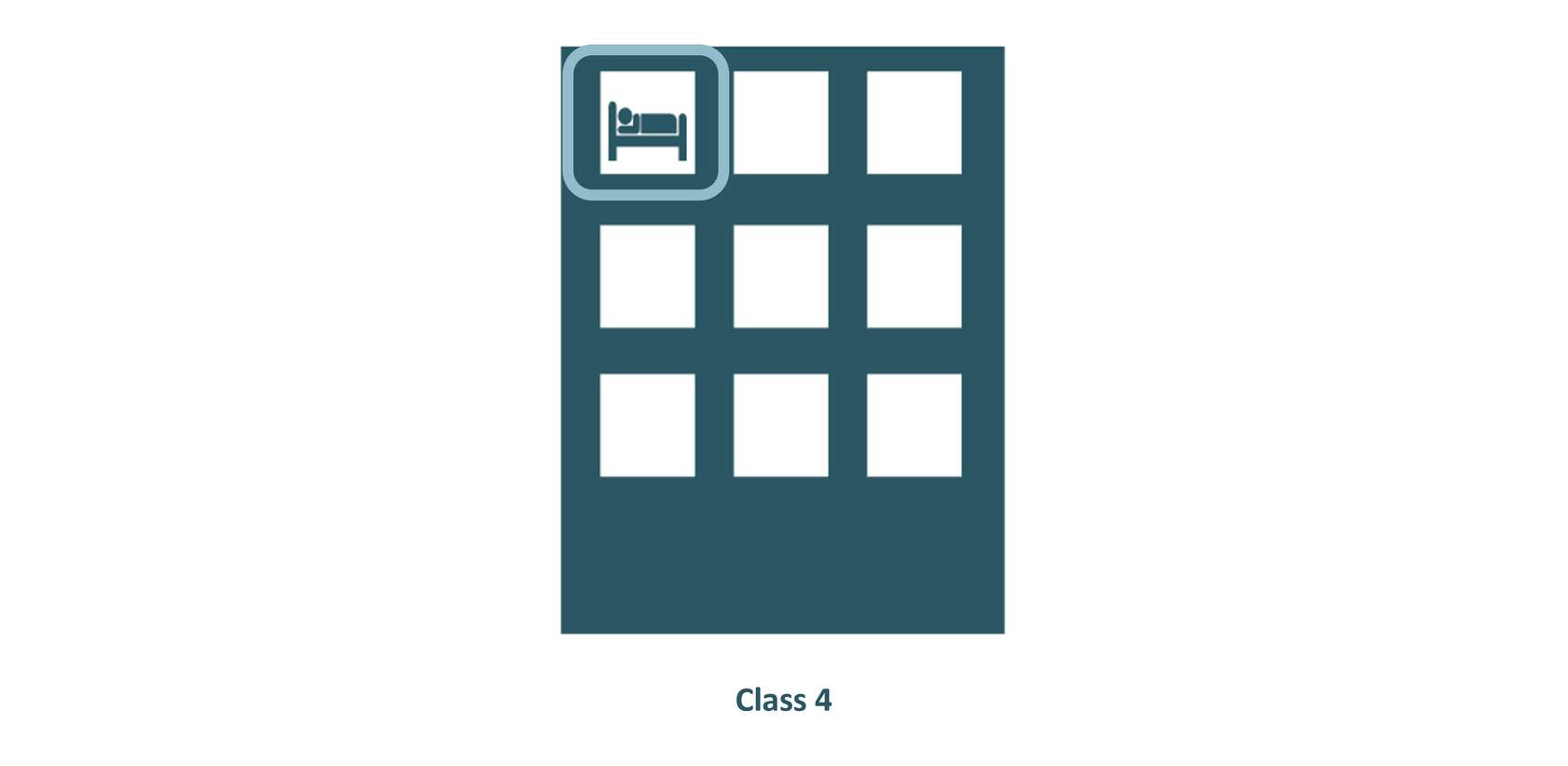
A Class 4 building is a dwelling in a Class 5, 6, 7, 8 or 9 building if it is the only dwelling in the building.
Note: A common example is caretaker’s accommodation in an otherwise non-residential building. This type of accommodation is not separately classified if it is in a Class 1, 2, 3 building.
‘Commercial’ classifications
Class 5Class 6Class 7Class 8Class 9
Class 5
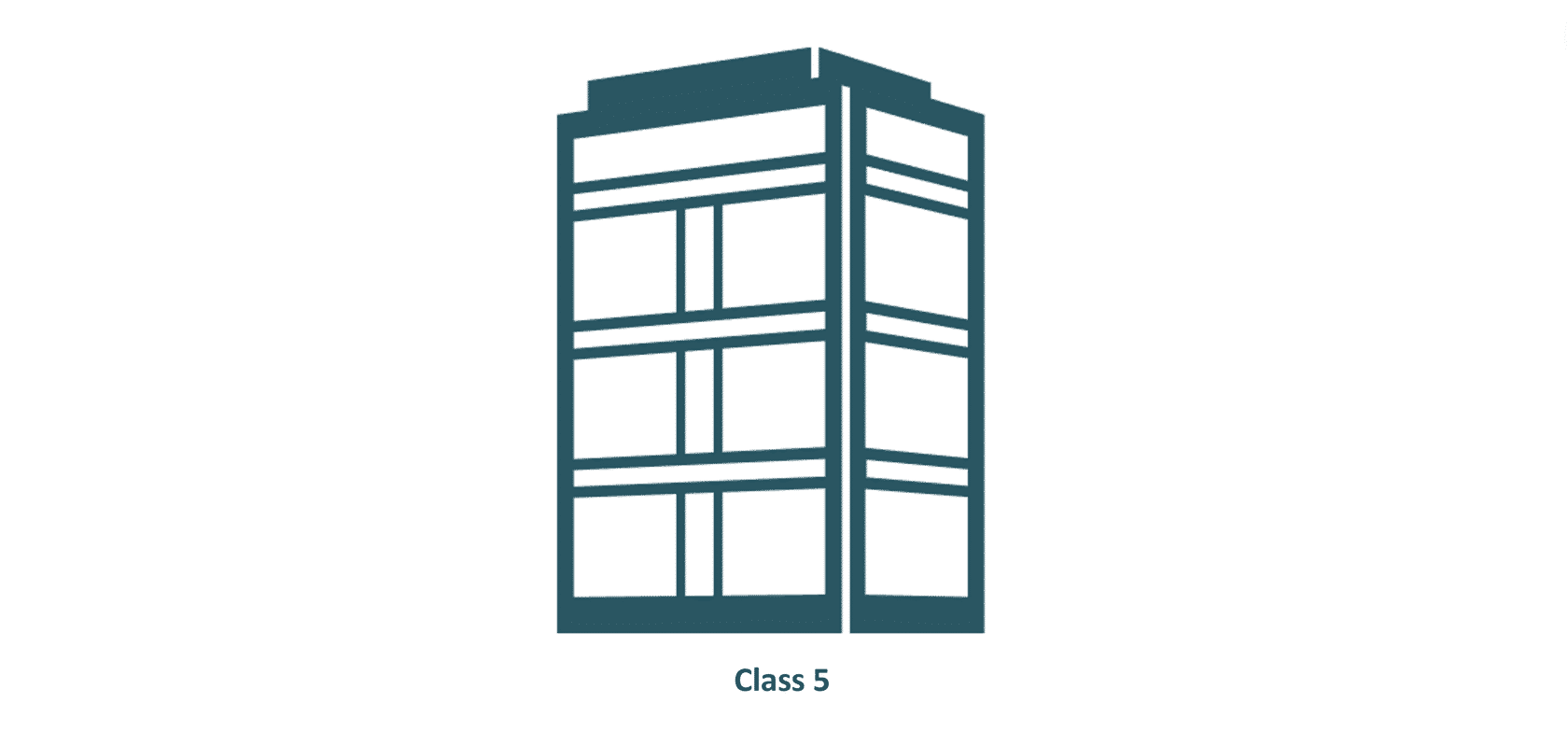
A Class 5 building is an office building used for professional or commercial purposes.
Class 6
(1) A Class 6 building is a shop or other building used for the sale of goods by retail or the supply of services direct to the public.
(2) Class 6 buildings include the following:
(a) An eating room, cafe, restaurant, milk or soft-drink bar.
(b) A dining room, bar area that is not an assembly building, shop or kiosk part of a hotel or motel.
(c) A hairdresser’s or barber’s shop, public laundry, or undertaker’s establishment.
(d) A supermarket or sale room, showroom, or service station.
Note: New South Wales and South Australia both vary this definition (see NSW A6G7 and SA A6G7 respectively).

Class 7
(1) A Class 7 building is a storage-type building.
(2) Class 7 includes the following sub-classifications:
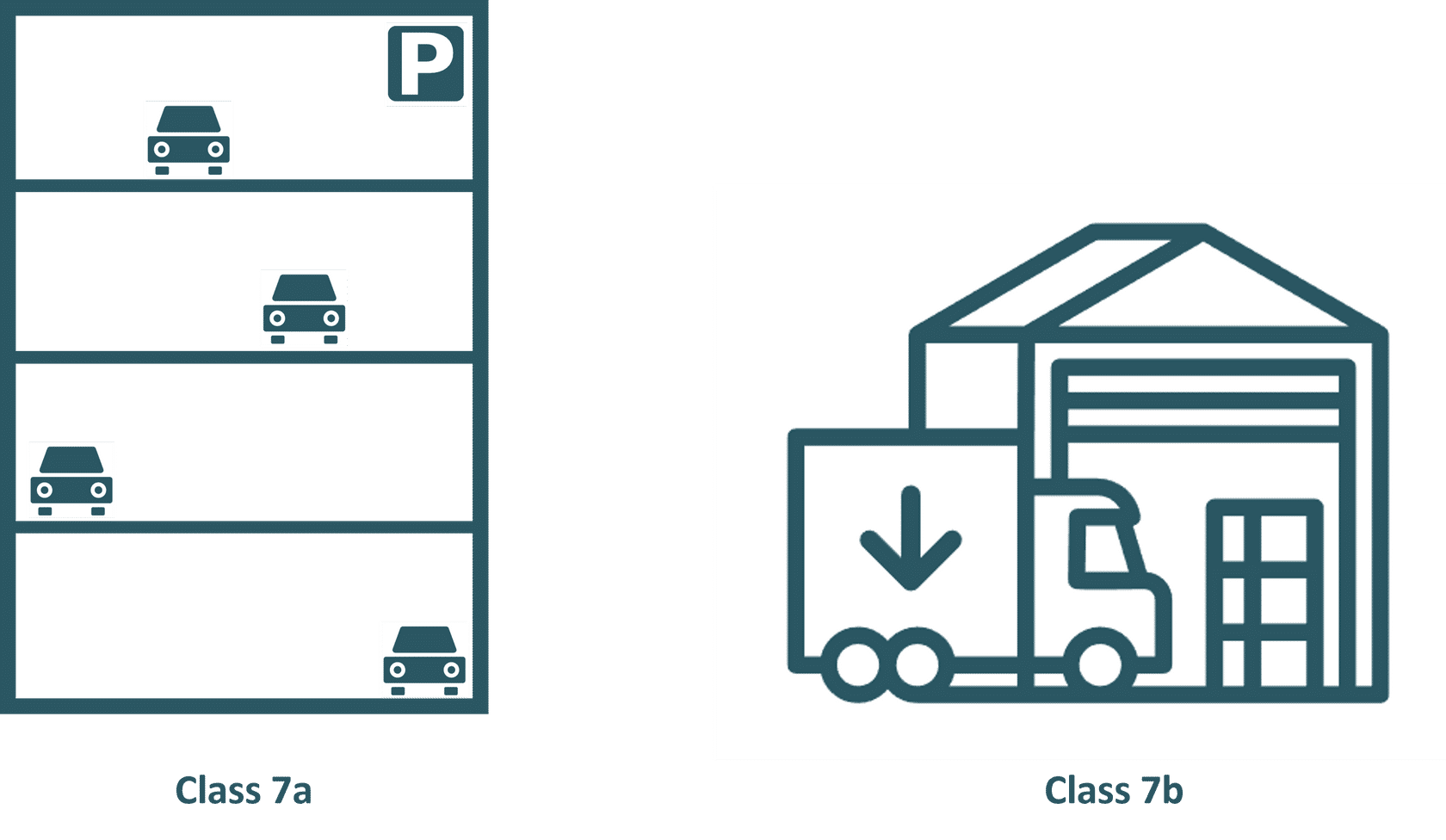
(a) Class 7a — a carpark.
(b) Class 7b — a building that is used for storage, or display of goods or produce for sale by wholesale.
Note: A carpark does not include a private garage as defined in the NCC.
Class 8
1) A Class 8 building is a process-type building.
(2) Class 8 buildings include the following:
(a) A laboratory.
(b) A building in which the production, assembling, altering, repairing, packing, finishing, or cleaning of goods or produce for sale takes place.
Note: Laboratories associated with some Class 9 buildings are not included in Class 8.

Class 9
1) A Class 9 building is a building of a public nature.
(2) Class 9 includes the following sub-classifications:
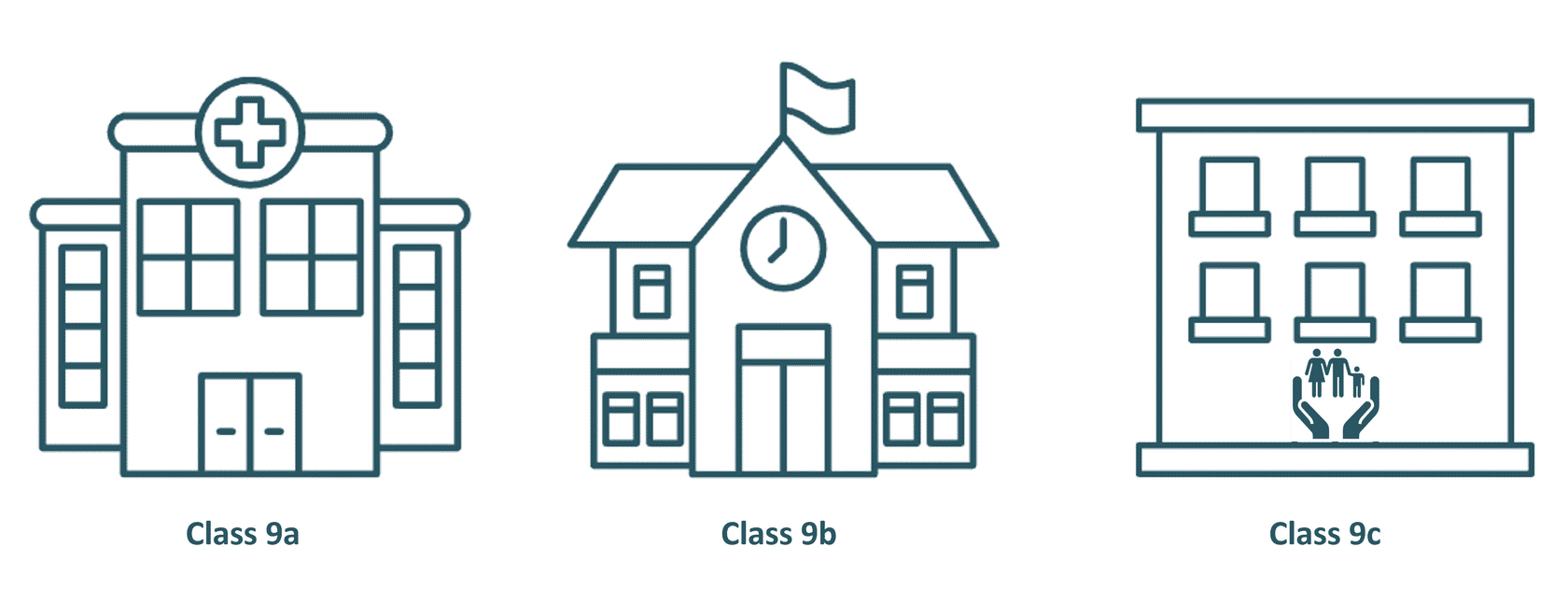
(a) Class 9a — a health-care building including any parts of the building set aside as laboratories, and includes a health-care building used as a residential care building.
(b) Class 9b — an assembly building including a trade workshop or laboratory in a primary or secondary school.
(c) Class 9c — a residential care building.
Note: this definition excludes any parts of the building that are of another Class, for example Class 3 residential accommodation for students at a school.
Non-habitable classifications
Class 10
(1) A Class 10 building is a non-habitable building or structure.
(2) Class 10 includes the following sub-classifications:
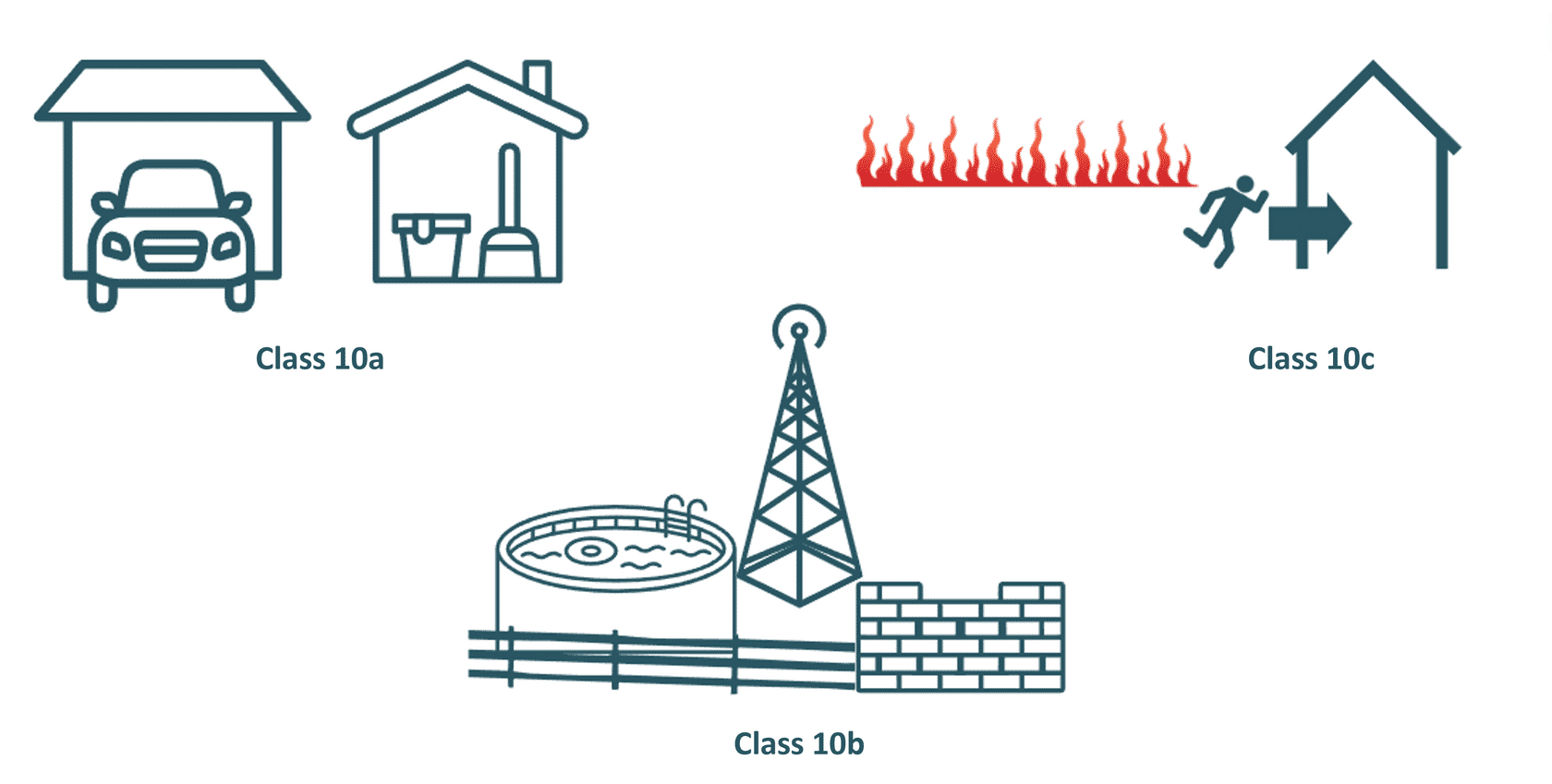
(a) Class 10a is a non-habitable building including a private garage, carport, shed or the like.
(b) Class 10b is a structure that is a fence, mast, antenna, retaining wall or free-standing wall or swimming pool or the like.
(c) Class 10c is a private bushfire shelter.
I
Note: with the exception of a private bushfire shelter, which must be associated with but not attached to a part of a Class 1a dwelling, a Class 10 building can be a separate structure or associated with or attached to any other classification of building. These buildings do not have to be associated with a Class 1 building.
Class 10 or unclassified in the NCC?
As we saw in Section 1, the NCC does not, and is not intended to, cover all possible types of structure. It can be tempting to say that all non-habitable structures are Class 10 buildings. However, while the subclassifications 10a and 10b include a diverse range of buildings, they also include the phrase ‘or the like’. There are some types of structures that are not like any of the structures listed in these classifications.

For buildings that do not appear to fit into these classifications, there may be local rules on whether they are regulated under building laws and have the BCA applied to them, or whether other laws and/or technical standards apply to them.
How many classifications are there?
For the purpose of the NCC Class 1a, 1b, 7a, 7b, 9a, 9b and 9c and 10a, 10b and 10c are separate classifications. This means there is effectively more than 10 classifications.
In the NCC, if the overall class is mentioned (e.g. Class 7) it includes any subclassifications (e.g. both Class 7a and Class 7b).
The NCC may also include provisions for particular building types within a classification but these are not separate classifications.
How to determine classification
As we’ve seen, a building’s classification (or the classification of part of a building) is “determined by the purpose for which it is designed, constructed or adapted to be used”.
Importantly, the rules for classification require that:
- bulletEach part of a building must be classified according to its purpose, and
- bulletComply with all the appropriate requirements for its classification.
- The minor use or ‘10%’ ruleThe exception to each part requiring its own classification is where that part is:
- Not more than 10% of the floor area of the storey it is on, and
- Not a laboratory, a Class 9b early childhood centre, or a Class 2, 3 or 4 part of a building (because these buildings have higher potential risks and unique hazards to the safety of occupants and must be built to standards for those classifications).
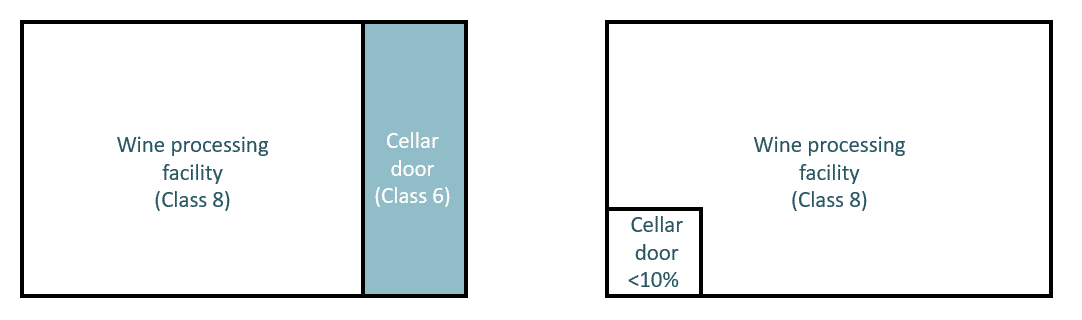
- ExampleA single storey wine processing facility building has a small cellar door from which it offers tastings and makes sales direct to the public. If:
- The floor area of cellar door area is 20%, it will need to be classified separately as a Class 6 part of the building and meet the Performance Requirements for a Class 6 building.
- If the floor area is only 10% of the total floorspace, it would be classified as a Class 8 with the rest of the storey and need to meet the Performance Requirements for a Class 8.
The NCC also has specific requirements for classifying rooms that contain mechanical, thermal or electrical facilities (or the like, other than an electricity network substation) that serve the building, and occupiable outdoor areas. (See A6G1 in the NCC)
Multiple classifications
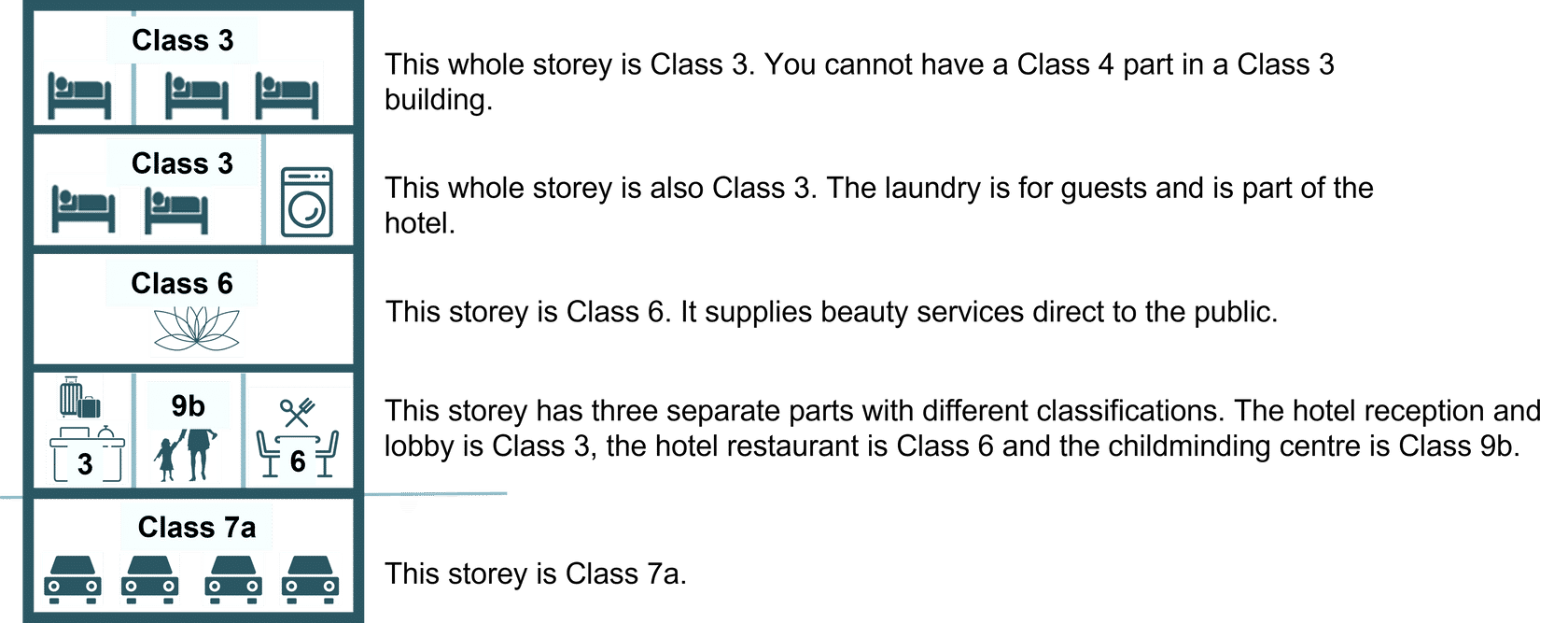
A building that has different parts with different classifications may also be referred to as a mixed-use building. Each part must comply with the relevant requirements for its classification.
A whole building could also have more than one classification – for example both Class 5 and Class 6, or both Class 2 and Class 3. In these cases, the building must comply with the most stringent requirements of all applicable classes.
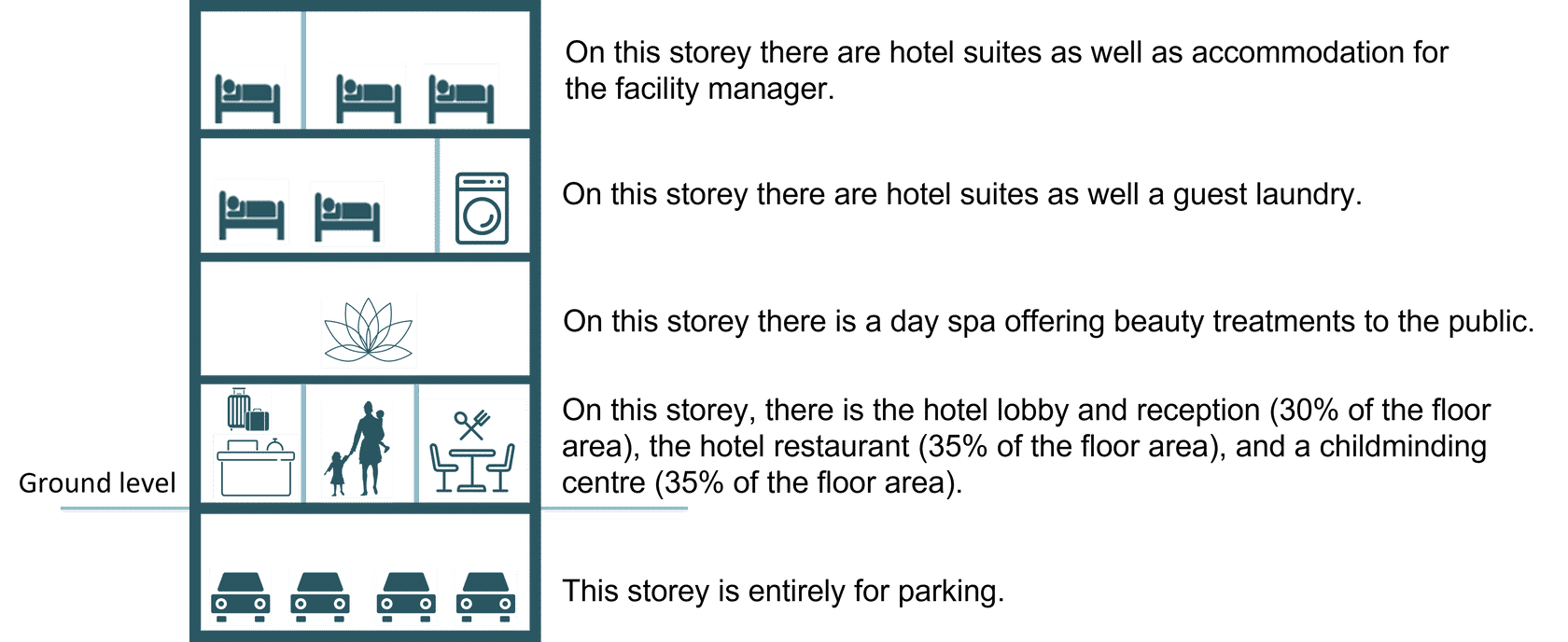
Consider this mixed use building and what its classifications will be. Refer to the definitions from the NCC above.
Check if you were right…